The Absorption Coefficient (α): The Starting Point
When a sound wave strikes a material, part of its energy is reflected and part is absorbed. The absorption coefficient (α) expresses this absorption capacity at a specific frequency, on a scale from 0 to 1: 0 a 1:
- α = 0 → the material reflects virtually all sound energy (e.g. concrete or glass).
- α = 1 → the material absorbs virtually all incident sound energy.
The key point is that no material performs the same across all frequencies. A panel may absorb mid- and high-frequency sounds (such as human speech) very effectively, while offering little performance at low frequencies.
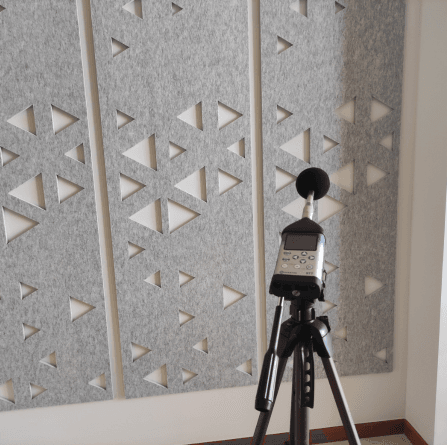
For this reason, the most meaningful data is not a single figure, but the sound absorption curve across frequency bands,measured under laboratory conditions according to norma UNE-EN ISO 354.
What Does NRC Actually Mean?
The Noise Reduction Coefficient (NRC) is the most widely used indicator in North American markets. It is calculated as the arithmetic mean of the sound absorption coefficients measured at 250, 500, 1,000 and 2,000 Hz, rounded to the nearest 0.05.
Its main advantage is clear: a single value that makes it easy to compare products quickly.
Its limitation is equally important: two panels with the same NRC may perform very differently at low or high frequencies because the average conceals the frequency response.
An NRC of 0.70 may result from balanced sound absorption… or from a peak at 2,000 Hz that compensates for poor performance at 250 Hz.
Conclusion: NRC is useful as an initial filter, but it should not be used as the sole specification criterion.
αw: The European Reference, Offering a More Representative Assessment
The αw (weighted sound absorption coefficient), defined by UNE-EN ISO 11654, goes one step further. It is obtained by fitting a reference curve to the measured values between 250 and 4,000 Hz, penalising frequency imbalances.
In addition, the standard classifies materials into absorption classes from A to E:
| Class | αw |
|---|---|
| A | 0,90 – 1,00 |
| B | 0,80 – 0,85 |
| C | 0,60 – 0,75 |
| D | 0,30 – 0,55 |
| E | 0,15 – 0,25 |
This classification is the standard reference in European specifications and certifications, and it is commonly required by architects and acoustic consultants in international projects.
When an αw value is accompanied by a shape indicator (L), (M) or (H), it indicates that the material performs above the reference curve at low, medium or high frequencies, providing valuable information depending on the intended application of the space.
The Same Coefficient Does Not Guarantee the Same Performance
Comparing a single number is the most common mistake.
The actual performance of an acoustic panel also depends on:
- Material thickness and density.
- Air cavity: leaving a gap between the panel and the wall or ceiling significantly improves sound absorption at low frequencies.
- Installation system: direct bonding, framing systems, suspended islands or vertical baffles do not deliver the same acoustic performance.
- Treated surface area and panel distribution within the room: panel placement is just as important as the number of panels.
- Room geometry and volume, which determine the target reverberation time.
The same panel can move from Class D to Class A simply by changing its installation method.
This is why laboratory test reports always specify the installation condition (Type A, E-200, etc.), and why this information should always be interpreted together with the acoustic performance data.

Beyond the Technical Data Sheet: Interpreting the Data to Design Better
A technical data sheet provides essential information, but interpreting it correctly is what distinguishes a decorative solution from a truly effective acoustic conditioning project.
It is not about choosing the highest coefficient, but about answering three key questions:
- Which frequencies dominate the noise in the space? Speech in offices and restaurants, music in multipurpose rooms, or low frequencies generated by technical installations.
- What is the target reverberation time according to the room's use and volume?
- What surface area and installation method are required to achieve the desired acoustic performance with the selected material?
Acoustics cannot be solved with a single figure. It is designed by combining multiple variables that work together.
Harmonium | Design Backed by Certified Acoustic Performance
At Harmonium, we believe that design and acoustic engineering should always go hand in hand.
We develop PET felt acoustic solutions whose aesthetics integrate seamlessly into each project without compromising certified acoustic performance, tested in accordance with international standards.
Our technical data sheets include αw, absorption class and NRC, together with the specified test conditions. This provides architects and interior designers with clear, verifiable and comparable information to specify the right solution for every project.
Because an acoustic panel should not be selected based solely on how it looks.
It should also be chosen based on proven acoustic performance and the way it shapes the sound of a space.